The technology industry is experiencing one of its biggest transformations since the rise of the internet.
Artificial Intelligence (AI), Machine Learning (ML), and Generative AI are changing how businesses operate, how software is built, and how employees work.
For professionals who have spent years working in SAP, .NET, Java, databases, testing, infrastructure, support, or other traditional IT roles, this shift can feel both exciting and intimidating.
Many experienced professionals wonder:
😐 Am I too late to learn AI?
😐 Will AI replace my current job?
😐 Do I need a PhD in Mathematics?
😐 Should I completely abandon my current career path?
The good news is that the answer to all these concerns is largely “NO.“
Your years of experience solving business problems, understanding systems, working with data, and communicating with stakeholders are valuable assets.
The smartest transition is not to start over, but to gradually build AI skills on top of your existing foundation.
Let’s explore a practical roadmap.
Recognize That Your Experience Is an Advantage
Many people assume that AI is a field reserved only for fresh graduates or research scientists.
In reality, businesses need professionals who understand both technology and business processes.
For example:
✨ SAP professionals understand enterprise workflows.
✨ .NET developers understand application architecture.
✨ Database administrators understand data management.
✨ Test engineers understand software quality.
✨ Business analysts understand user requirements.
AI solutions still need to solve business problems.
Your domain expertise gives you a significant advantage over someone who knows AI algorithms but lacks industry knowledge.
Instead of thinking, “I am behind,” think, “I already have part of the puzzle.”
Learn the Fundamentals of AI Before the Tools
One common mistake is jumping directly into advanced tools without understanding the basics.
Before exploring frameworks and platforms, learn:
🤔 What is Artificial Intelligence?
🤔 What is Machine Learning?
🤔 What is Deep Learning?
🤔 What are Neural Networks?
🤔 What are Large Language Models (LLMs)?
🤔 What is Generative AI?
At this stage, focus on understanding concepts rather than memorizing technical details.
A strong conceptual foundation will make every future learning step easier.
Learn Python at a Comfortable Pace
Python has become the most widely used programming language in AI and data science.
The good news is that you do not need to master Python overnight.
Start with:
🎠 Variables
🎠Data types
🎠Conditional statements
🎠Loops
🎠Functions
🎠Lists and dictionaries
🎠File handling
Even if you dedicate only a few hours each week, your skills will gradually improve.
For experienced IT professionals, consistency is far more important than speed.
Become Comfortable Working with Data
Data is the fuel that powers AI systems.
Before building machine learning models, learn how data is collected, stored, cleaned, and analysed.
Focus on:
💛 SQL
💛 Excel analytics
💛 Data visualization
💛 Data cleaning techniques
💛 Basic statistics
Professionals who understand data often find AI concepts much easier to grasp.
Remember: Many successful AI projects fail not because of poor algorithms but because of poor data quality.
Start Using AI in Your Daily Work
One of the easiest ways to enter the AI world is simply to become an active user.
Use AI tools for:
⛳ Documentation
⛳ Code assistance
⛳ Requirement analysis
⛳ Report generation
⛳ Learning new technologies
⛳ Brainstorming solutions
By using AI regularly, you begin to understand both its strengths and limitations.
This practical exposure is often more valuable than reading dozens of theoretical articles.
Connect AI with Your Existing Domain
Rather than making a complete career switch, look for opportunities to combine AI with your current expertise.
For SAP Professionals
💥 AI-driven ERP analytics
💥 Intelligent automation
💥 Demand forecasting
💥 Predictive maintenance
For .NET Developers
💥 AI-powered web applications
💥 Chatbots
💥 Recommendation systems
💥 Intelligent document processing
For Test Engineers
💥 Automated test generation
💥 AI-assisted quality assurance
💥 Defect prediction
For Database Professionals
💥 Data engineering
💥 Data pipelines
💥 AI-ready data platforms
The most successful transitions usually happen when professionals build on what they already know.
Build Small Projects Instead of Chasing Certifications
Certifications can be useful, but practical experience is far more valuable.
Start with small projects such as:
🤖 A chatbot using an LLM API
🤖 A movie recommendation system
🤖 A sales prediction model
🤖 A document summarizer
🤖 A simple image classifier
Small projects help you understand how concepts work in real-world scenarios.
They also build confidence and create a portfolio that demonstrates your skills.
Learn the Mathematics Gradually
The mention of mathematics scares many experienced professionals away from AI.
The reality is much less frightening.
Initially, focus on understanding:
🪴 Basic statistics
🪴 Probability
🪴 Linear algebra concepts
🪴 Data interpretation
You do not need advanced mathematics on Day One.
As your understanding grows, you can gradually explore the mathematical foundations behind machine learning algorithms.
Many professionals successfully enter AI while learning mathematics alongside their projects.
Explore AI-Related Career Paths
AI is much broader than becoming a Machine Learning Engineer.
Possible roles include:
🔔 AI Product Manager
🔔 Data Analyst
🔔 Data Engineer
🔔 AI Consultant
🔔 Prompt Engineer
🔔 Business Intelligence Specialist
🔔 AI Solutions Architect
🔔 MLOps Engineer
Understanding the variety of roles available can help you choose a path that matches your strengths and interests.
Think Long-Term and Stay Patient
Perhaps the most important advice is to avoid comparing yourself to others.
Social media often creates the impression that everyone is becoming an AI expert overnight.
In reality, meaningful career transitions take time.
If you invest:
🌐 5–6 hours per week
🌐 Learn consistently
🌐 Build projects
🌐 Stay curious
You can make remarkable progress within a year.
The goal is not to become an AI researcher next month.
The goal is to become a stronger technology professional next year.
LET’S DO IT
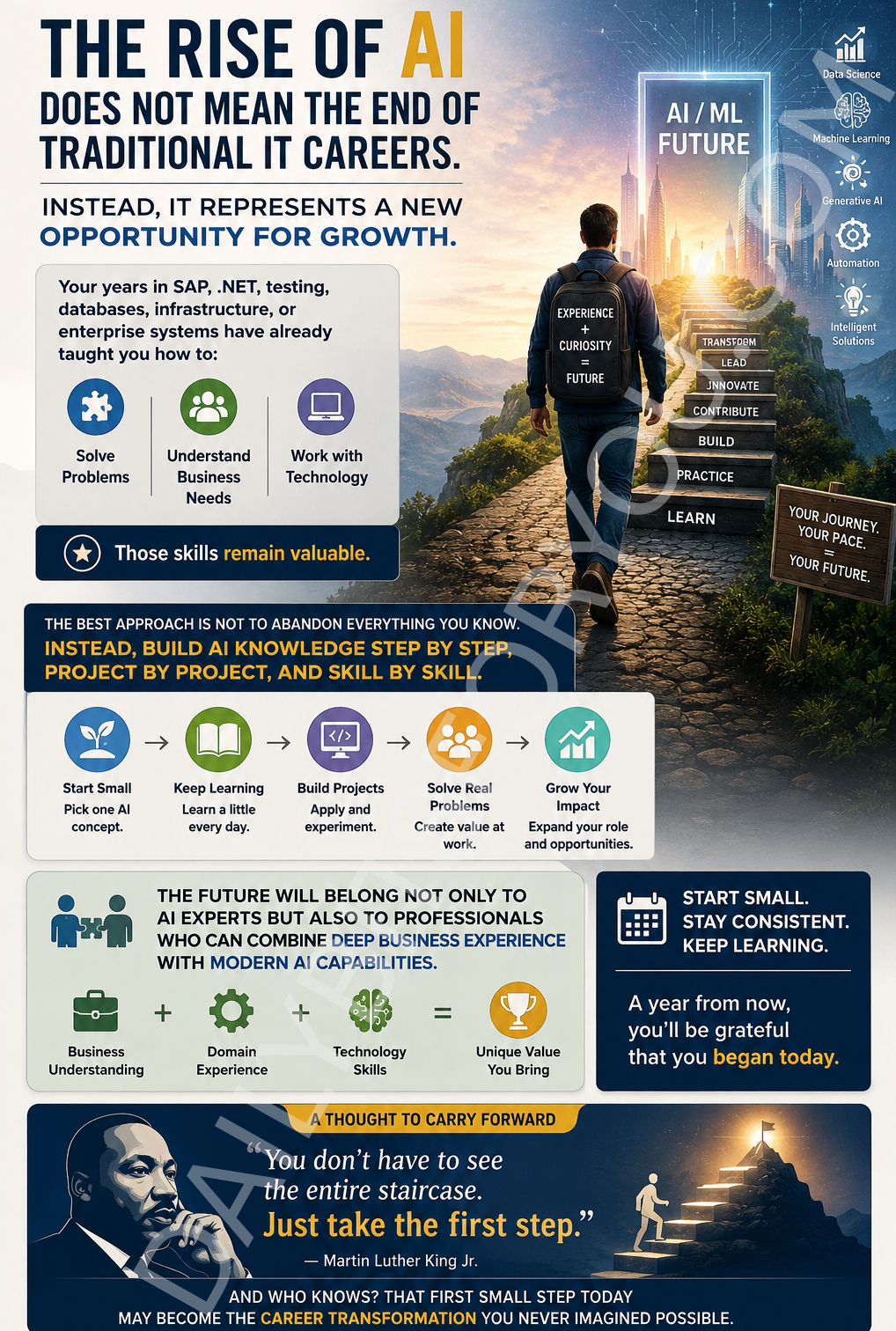
The rise of AI does not mean the end of traditional IT careers. Instead, it represents a new opportunity for growth.
Your years in SAP, .NET, testing, databases, infrastructure, or enterprise systems have already taught you how to solve problems, understand business needs, and work with technology.
Those skills remain valuable.
The best approach is not to abandon everything you know. Instead, build AI knowledge step by step, project by project, and skill by skill.
The future will belong not only to AI experts but also to professionals who can combine deep business experience with modern AI capabilities.
Start small. Stay consistent. Keep learning.
A year from now, you’ll be grateful that you began today.
A Thought to Carry Forward
“You don’t have to see the entire staircase. Just take the first step.” — Martin Luther King Jr.
And who knows? That first small step today may become the career transformation you never imagined possible.