INTRODUCTION
⏰ Every day, billions of people interact with computers through keyboards, touchscreens, microphones, and cameras.
We communicate using languages such as English, Telugu, Hindi, or Chinese, while computers are electronic machines built from tiny switches and circuits.
❓ This creates an important challenge: how can humans and computers understand one another?
🧠 The answer lies in computer languages.
📝Over the decades, humans have developed increasingly sophisticated ways to translate our thoughts into forms that computers can process.
To understand why computers require their own language, we must first understand how they store information, how they interpret instructions, and how programming languages have evolved throughout history.
WHY DO COMPUTERS NEED THEIR OWN LANGUAGE
🧍🏻♂️🧍🏻♀️ Humans communicate using words, sounds, symbols, and gestures.
👍🏻👎🏼Computers, however, are electronic devices whose circuits can exist in only two states: ON and OFF.
👀 Because of this fundamental limitation, computers cannot directly understand human languages.
Instead, they rely on a language based on these two states, represented by the digits 1 and 0.
💥Every action performed by a computer, from displaying a photograph to launching a spacecraft, ultimately depends on interpreting patterns of ones and zeros.
THE COMPUTER’S NATIVE TONGUE: THE MACHINE LANGUAGE
✅The simplest and most fundamental language understood by a computer is called machine language.
👨💻Machine language consists entirely of binary digits, or bits.
For example:
10110000 01100001
📰To a human reader, these symbols appear meaningless.
🤩To a computer processor, however, they represent precise instructions that can be executed directly.
💻Machine language is fast and efficient because no translation is required, but it is also extremely difficult for humans to read and write.
THE LANGUAGE OF ONES AND ZEROS
Binary code is the foundation of all computing. Unlike the decimal system used by humans, which contains ten digits (0–9), the binary system uses only two digits:
⌨️ = OFF
⌨️ = ON
These two symbols are sufficient because the electronic components inside a computer can easily distinguish between two electrical states.
Whether it is text, music, images, videos, or software, every piece of information stored inside a computer eventually becomes a sequence of binary digits.
FROM HUMAN WORDS TO BINARY CODES
📙One of the most fascinating aspects of computing is the conversion of human-readable information into binary form.
🔴Consider the letter “A”. Computers use encoding systems such as ASCII and Unicode to assign numbers to characters. In ASCII, the letter A corresponds to the number 65.
A → 65 → 01000001
Similarly, the word “CAT” becomes:
C → 67 → 01000011
A → 65 → 01000001
T → 84 → 01010100
Thus, the word CAT is stored as:
01000011 01000001 01010100
Numbers can also be converted into binary. For example, the decimal number 13 is represented in binary as: 1101
When you press a key on your keyboard, type a message, or save a document, your computer automatically converts the information into binary code. This translation happens millions of times per second and forms the basis of all digital communication.
COMMUNICATING WITH THE EARLY COMPUTERS
⌨️ Modern computers allow users to interact through keyboards, screens, and touch interfaces. Early computers, however, had much more primitive methods of communication.
🔴One common method involved punched cards. Information was represented by holes punched into stiff paper cards. A hole represented one value, while the absence of a hole represented another.
🍏 Another method used paper tape, which stored information as patterns of holes along a long strip of paper.
🔛 Some of the earliest computers even required programmers to manually flip switches on control panels to enter binary instructions directly into memory.
These methods were slow, cumbersome, and prone to errors, motivating the development of better programming tools.
THE BIRTH OF THE PROGRAMMING LANGUAGES
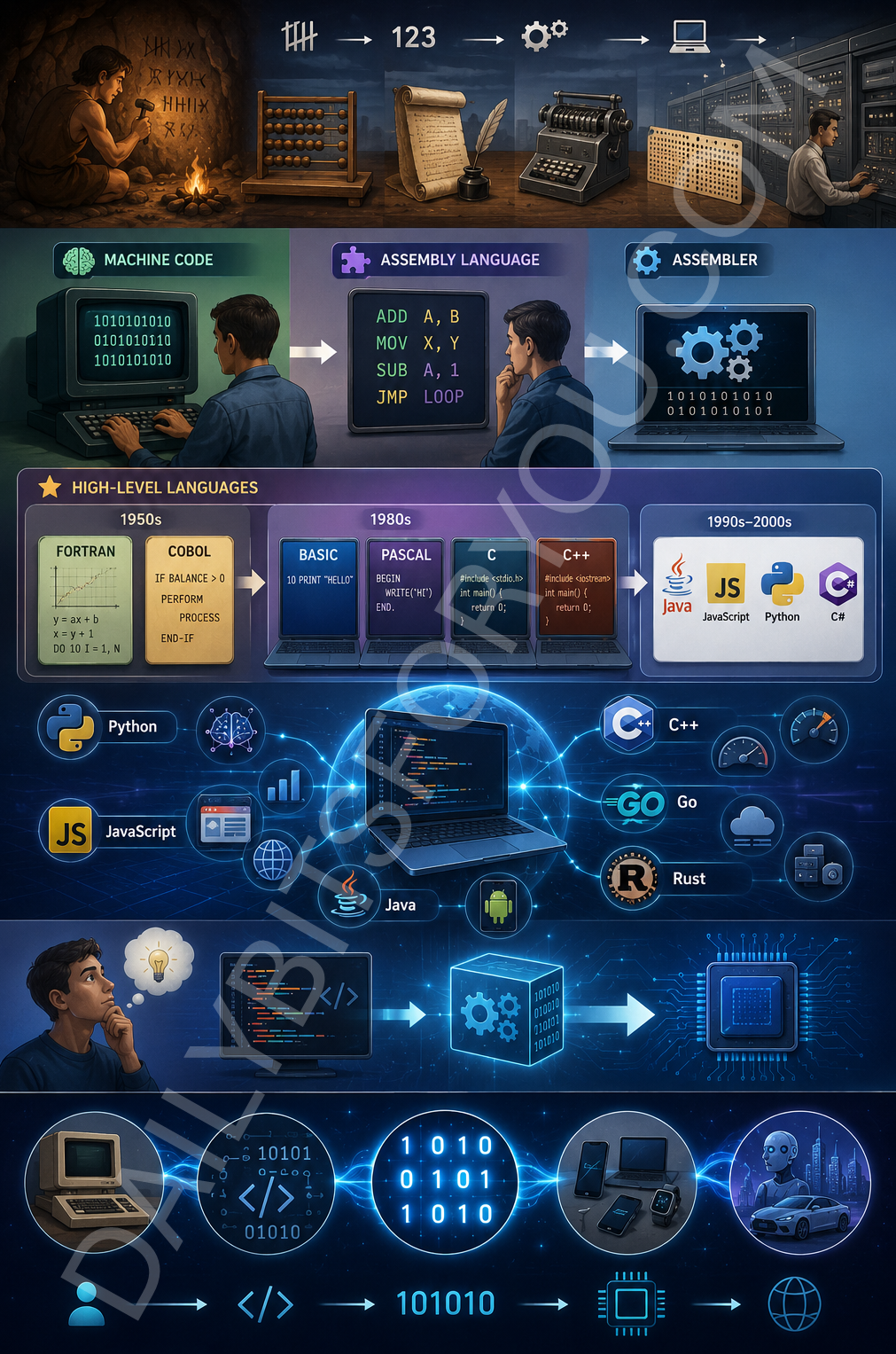
⌨ Programming early computers in binary was a tedious task. To simplify the process, programmers developed assembly language.
Instead of writing binary numbers, programmers could write symbolic instructions such as:
ADD A, B
MOV X, Y
💻 A special program called an assembler translated these symbols into machine code.
💻 Assembly language was a major improvement, but programming still required detailed knowledge of computer hardware.
FROM MACHINE CODE TO MODERN LANGUAGES
✍️ The next major step was the development of high-level programming languages.
💬 During the 1950s, FORTRAN was introduced for scientific and engineering calculations, while COBOL was designed for business applications.
💻 As computers became more powerful, languages such as BASIC, Pascal, C, and C++ emerged. These languages made programming more accessible and encouraged the development of increasingly complex software.
The 1990s and 2000s saw the rise of Java, JavaScript, Python, and C#, which further increased programmer productivity and portability.
Today, modern languages allow programmers to express complex ideas in ways that closely resemble human reasoning, while compilers and interpreters handle the translation into machine code.
PROGRAMMING LANGUAGES IN THE MODERN ERA
🐛 Several programming languages dominate the computing landscape today.
🐍 Python is widely used for artificial intelligence, data science, automation, and education.
🖥 JavaScript powers interactive websites and web applications.
Java remains important in enterprise software and mobile development.
C++ continues to be used in game engines, operating systems, and high-performance applications.
Go and Rust have gained popularity for cloud computing, distributed systems, and modern systems programming.
Although these languages appear very different from machine language, they all ultimately produce the binary instructions that computers understand.
A THOUGHT AND A SUMMARY FOR YOU!
💻 Computers require a separate language because they operate fundamentally differently from humans.
🧠 While people think in words, concepts, and ideas, computers process electrical signals represented by binary digits.
💻 Machine language and binary code form the foundation of all computing, while programming languages provide a bridge between human thought and machine execution.
🕰️ Over time, these languages have evolved from difficult binary instructions to powerful modern tools that enable software development, artificial intelligence, scientific research, and countless other innovations.
Despite this evolution, every command given to a computer eventually becomes the same thing: a carefully organized sequence of ones and zeros.