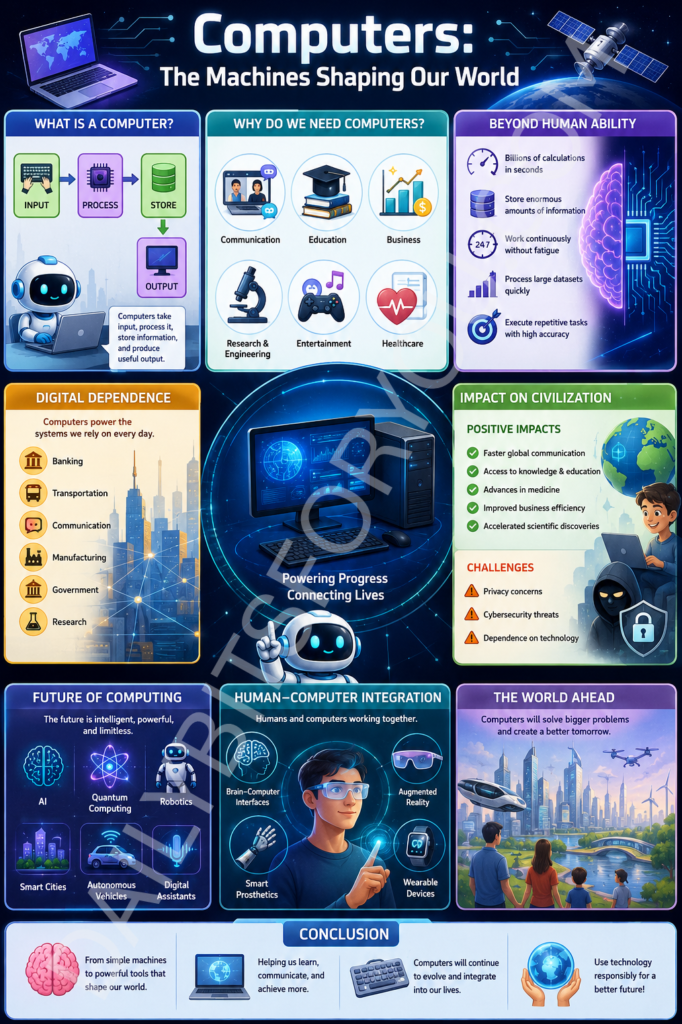
WHAT WE KNOW!
⭐️Computers have become an essential part of modern life.
⭐️From smartphones and laptops to satellites and medical equipment, computers are everywhere.
⭐️They help us communicate, learn, work, and solve complex problems.
⭐️Understanding what computers are and how they influence society helps us appreciate their importance and prepare for the future.
What Is a Computer?
A computer is an electronic machine that receives information, processes it according to instructions, and produces useful results.
In simple terms, a computer:
🟢Takes input (data)
🟣Processes the data
🟢Stores information
🟣Produces output
For example, when you type a message on a keyboard, the computer processes your input and displays the text on the screen.
Why Do We Need Computers?
Computers help us perform tasks faster, more accurately, and more efficiently.
Some important uses include:
🟢Communication through emails, messaging, and video calls
▪️Education and online learning
🟢Business and financial management
▪️Scientific research and engineering
🟢Entertainment such as games, music, and movies
▪️Healthcare and medical diagnosis
Without computers, many modern services would become slow and difficult to manage.
Beyond Human Ability
Humans are intelligent and creative, but computers excel in certain areas.
Computers can:
💬Perform billions of calculations in seconds
💬Store enormous amounts of information
💬Work continuously without fatigue
💬Process large datasets quickly
💬Execute repetitive tasks with high accuracy
While humans think, imagine, and make judgments, computers provide speed, precision, and consistency.
Digital Dependence
Society relies heavily on computers because they improve productivity and connectivity.
Today, computers control:
🪙Banking systems
🪙Transportation networks
🪙Communication services
🪙Manufacturing industries
🪙Government operations
🪙Scientific and technological research
As the world becomes more interconnected, computers help manage the growing amount of information and services.
Impact on Civilization
Computers have transformed human civilization in many ways.
Positive impacts include:
✅Faster communication across the globe
✅Greater access to knowledge and education
✅Advances in medicine and healthcare
✅Improved business efficiency
✅Accelerated scientific discoveries
However, computers have also created challenges such as privacy concerns, cybersecurity threats, and dependence on technology.
Overall, their influence has been one of the most significant developments in human history.
Future of Computing
The future of computing is expected to be more powerful, intelligent, and accessible.
Emerging technologies include:
👨💻Artificial Intelligence (AI)
👨💻Quantum Computing
👨💻Advanced Robotics
👨💻Smart Cities
👨💻Autonomous Vehicles
👨💻Personalized Digital Assistants
Future computers may solve problems that are currently impossible for even the most powerful machines today.
Human–Computer Integration
Scientists are already exploring ways to connect humans and computers more closely.
Examples include:
⚡️Brain-computer interfaces
⚡️Advanced prosthetic limbs controlled by thoughts
⚡️Augmented reality systems
⚡️Wearable computing devices
In the future, humans and computers may work together more seamlessly, allowing people to interact with technology using thoughts, gestures, and natural communication. However, ethical and safety concerns will remain important considerations.
Conclusion
🧠Computers have evolved from simple calculating machines into powerful tools that influence nearly every aspect of modern life.
💻They help us solve problems, communicate across great distances, and achieve scientific breakthroughs.
⌨As technology continues to advance, computers will become even more integrated into society and perhaps even into the human body itself.
🤩By understanding and using computers responsibly, humanity can harness their power to build a more connected, efficient, and innovative future.