Imagine you are a fresh Mechanical Engineering graduate who wants to transition into IT and eventually work in Machine Learning (ML).
The good news is that your engineering background already gives you many skills that ML requires: mathematics, problem-solving, analytical thinking, and working with data.
What is Machine Learning?
Machine Learning is a branch of Artificial Intelligence (AI) that enables computers to learn patterns from data and make predictions or decisions without being explicitly programmed for every situation.
Everyday Examples
🟢Netflix recommending movies
🟢YouTube suggesting videos
🟢Google Maps predicting traffic
🟢Email spam detection
🟢Voice assistants like Siri and Alexa
Instead of writing rules such as: “If a customer buys product A, recommend product B” an ML system learns such patterns automatically from historical data.
DIFFERENCES BETWEEN AI, ML, DL
Many beginners confuse AI and ML.
Artificial Intelligence (AI) is the broader field of creating intelligent systems.
Machine Learning (ML) is a subset of AI that learns from data.
Deep Learning (DL) is a subset of ML that uses neural networks.
⭐️AI → ML → Deep Learning⭐️
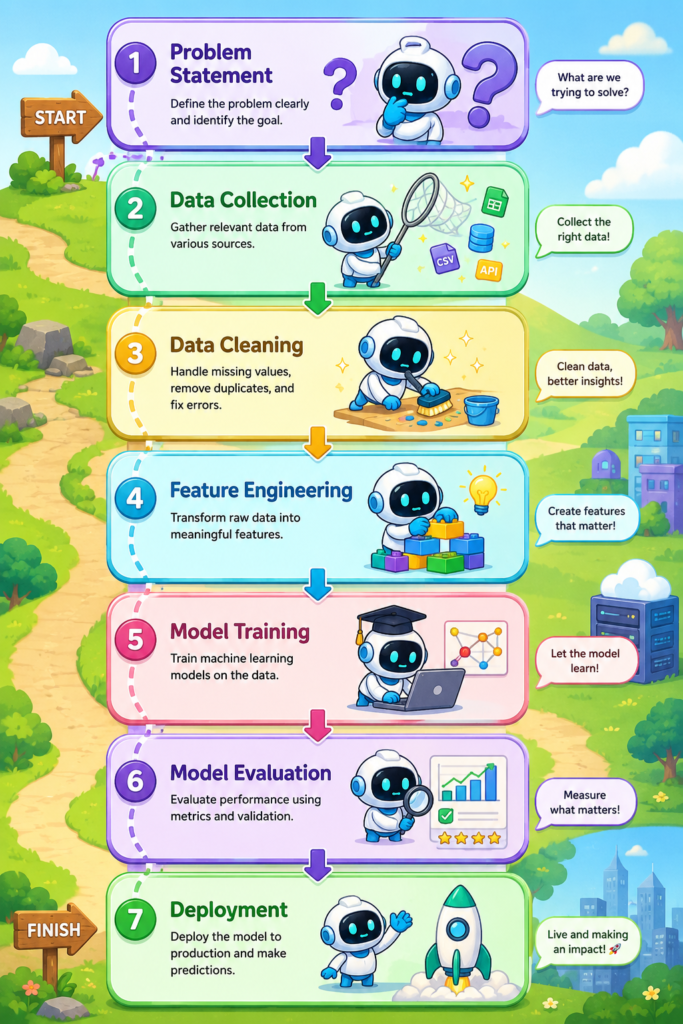
🔽A simple ML workflow would look like: 🔽
Why ML is a Good Career Option?
Machine Learning is used in:
✨ Software companies
✨ Healthcare
✨ Finance
✨ Manufacturing
✨ Robotics
✨ Automotive industries
✨ Aerospace
As a Mechanical Engineer, you can even work in domains where ML meets engineering:
🛎️Predictive maintenance
🛎️Quality inspection
🛎️Industrial automation
🛎️Smart manufacturing
🛎️Robotics
🛎️Digital twins
Prerequisites for Learning ML
Before jumping into ML algorithms, build foundations in three areas:
1. Mathematics
Focus on: Linear Algebra, Vectors, Matrices, Probability & Statistics, Mean, variance, Distributions, Hypothesis testing, Calculus, Derivatives, Gradients
You don’t need PhD-level math initially, but understanding the basics is important.
2. Programming
The most popular language for ML is: Python 👩💻
Learn: Variables, Loops, Functions, Object-Oriented Programming, File handling,
Then move to: NumPy, Pandas, Matplotlib
These libraries help manipulate and visualize data.
3. Data Handling
ML works on data.
Learn: CSV files, Excel datasets, Data cleaning, Data visualization, Basic SQL
Useful tools include: Jupyter Notebook, MySQL
Core Machine Learning Concepts
1. Supervised Learning
The algorithm learns from labeled data.
Examples: Predicting house prices, Predicting student scores
Common algorithms: Linear Regression, Logistic Regression, Decision Trees, Random Forest
2. Unsupervised Learning
The algorithm finds patterns without labels.
Examples: Customer segmentation, Grouping similar products
Common algorithms: K-Means Clustering, Hierarchical Clustering
3. Deep Learning
A specialized area of ML inspired by the human brain.
Used in: Image recognition, Self-driving cars, Speech recognition, Chatbots
Frameworks: TensorFlow, PyTorch
Recommended Learning Roadmap
Phase 1: Programming Fundamentals (1-2 Months)
Learn: Python, Data structures, Basic SQL
Build: Calculator, Student Management System, Data analysis mini-projects
Phase 2: Mathematics & Data Analysis (1 Month)
Learn: Statistics, Probability, Linear Algebra basics
Practice: Data visualization, Data cleaning
Phase 3: Machine Learning Fundamentals (2-3 Months)
Learn: Regression, Classification, Clustering, Model evaluation
Use: Scikit-learn
Projects: House price prediction, Employee attrition prediction, Sales forecasting
Phase 4: Deep Learning (2 Months)
Learn: Neural Networks, CNNs, RNNs, Transformers (basic understanding)
Projects: Image classification, Sentiment analysis, Chatbot
Phase 5: Portfolio Building
Create 4–6 projects and upload them to: GitHub
Examples: Predictive Maintenance System, Manufacturing Defect Detection, Energy Consumption Prediction, Vehicle Failure Prediction
These projects can connect your Mechanical Engineering background with ML.
Total: Approximately 8–10 months of focused study.
FINAL ADVICE
🚨 Do not think of yourself as “starting from zero.” 🚨
A Mechanical Engineering graduate already possesses:
✅ Mathematical reasoning
✅ Engineering problem-solving
✅ Analytical thinking
✅ Experience with technical subjects
Those skills transfer very well into Machine Learning. Focus first on Python and data analysis, then gradually move into ML algorithms and projects.
⭐️Consistency matters more than speed; even 2–3 hours of study daily can prepare you for ML internships or entry-level AI/ML roles within a year.⭐️
“In AI/ML, projects are often more important than certificates because they demonstrate practical skills.”